 Discovered by Ahounta Djimdoumalbaye in 2001 in the southern Saharan
desert of Chad, this fossil find was indirectly dated using animal bones
found in context and has an estimated age between 6.7 and 6.3 million years
ago.
Discovered by Ahounta Djimdoumalbaye in 2001 in the southern Saharan
desert of Chad, this fossil find was indirectly dated using animal bones
found in context and has an estimated age between 6.7 and 6.3 million years
ago.
Discovered by Ahounta Djimdoumalbaye in 2001 in the southern Saharan
desert of Chad, this fossil find was indirectly dated using animal bones
found in context and has an estimated age between 6.7 and 6.3 million years
ago.
The fossil remains include: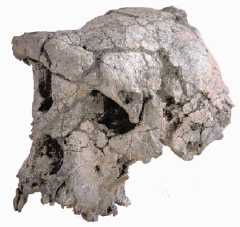
- a near complete cranium
- fragments of a lower jaw
- and teeth
- This skeleton was probably and adult male.
Evidence suggests that this species was a broad resource user (multi adaptive). The site contained a great variety of animal species found in context with Toumai.
Toumai Site in Sahara Desert
Toumai has a mix of primitive and advanced traits. He has some human traits
whereas, for his age, it is expected that he would be more apelike. Examination
of the foramen magnum (hole at base of skull through which the spinal cord
attaches to the brain) suggests he was a possible biped. His short canines
and thick tooth enamel were more human than ape. Most interesting though
is his flat face. This trait is completely absent in Australopithecus. Therefore,
Toumai may not be an ancestor of Australopithecus and perhaps is a closer
relative to the Homo genus. This find supports the adaptive radiations view
of evolution by adding further diversity to the archaelogical record of hominids.
Links:
Sahelantropus
Toumai, Monkey or Man?
Africa Online: Toumai article
Origins of Humankind (PBS)