1) 27.6 g K2CO3 = 0.200 mol K2CO3
0.200 mole K2CO3 = 0.0167 mol K2Zn3[Fe(CN)6]
0.0167 mol K2Zn3[Fe(CN)6] = 11.6
g K2Zn3[Fe(CN)6]
2) CxHy
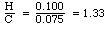
3.30 g CO2 = 0.075 mol C
0.899 g H2O = 0.050 mol H2O = 0.100 mol H
C1H1.33.... or C3H4
Addendum 9/26/99: The empirical and molecular formula are the same.
3) C2H7N
Addendum 9/26/99: According to Avogadro's Hypothesis, equal volumes of gases at
the same temperature and pressure contain an equal number of molecules of
gas. 1 volume = 1 mole in the equation that contains all gaseous
substances. Empirical formula and molecular formula are the same.
4) Let x = g of Cu2O
And y = g of CuO
Then x + y = 1.000

.888(1 - y) + y(0.799) = 0.839
y = 0.55.. or 55% CuO... or 0.55 g in a 1.000 gram sample.
5) Since 1 BaBr2 = 1 BaCl2

Solving for at. wt. of Ba gives 137
6) Let x = weight of KBr and let y = weight of NaBr
x + y = 0.560 gram
Weight of AgBr from KBr = 1.57x since 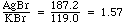
Weight of AgBr from NaBr = 1.82y since 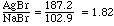
1.57x + 1.82y = 0.970
Solve two equations in x and y simultaneously
Gives KBr = x = 0.197

7) The commercial isolation of tungsten begins with the mineral Scheelite, the principal component of which is calcium tungstate (CaWO4), which is in turn converted to tungstic acid, the hydrous (hydrated) oxide (H2WO4), by treatment with concentrated hydrochloric acid (HCl). At elevated temperatures, tungstic acid can be reduced in a charcoal lined furnace directly to the pure metal. (For helpful information, see the discussion of the incandescent light bulb and the tungsten filament on the handout.)
(a) Write a balanced chemical equation for the reduction step in which tungstic acid is reduced to the metal.
H2WO4 + heat = H20 + WO3
WO3 + 3H2 = W + 3H2O
(b) In the key reduction step, a 100. gram sample of pure tungstic oxide is reduced (as described above) with 10.0 grams of charcoal. What is the limiting reagent and the maximum yield (in grams) of tungsten that can be realized by this process? Assume charcoal to be pure carbon.
2WO3 + 3C = 2W + 3CO2
Limiting reagent is tungstic oxide.
Maximum yield of W is 79g.
Addendum 9/26/99: 7.76 g carbon is needed for 100 g of WO3. You
have 10 g so carbon is
in excess and WO3 is limiting.
8) A mixture of calcium tungstate (CaWO4) and iron tungstate (FeWO4) weighed 1.0 grams. Both of these insoluble tungstates were converted to the soluble sodium tungstate (Na2WO4) which also weighed 1.0 grams. Determine the percent calcium tungstate in the mixture, assuming only those two substances are present.
Addendum 9/26/99: The answer is 38.5% FeWO4, not 33.3%.
9) To estimate the number of tungsten atoms in a 15-watt light bulb filament, see the incandescent light bulb discussion in the handout. Here are two ways to approach this problem, both of which should give you an order-of-magnitude result:
First: Using the statement that 1 lb of tungsten light bulb filament produces 200 miles of filament and that 30 inches of this filament is needed for a 15 watt bulb gives a result of about 4x10 to the 18th atoms.
Second: Using the statement that the tungsten filament used in the
bulb is 1/100mm or about 0.0004 inches in diameter, assuming the
filament is a solid rod of uniform diameter and known length, and
estimating the density of tungsten to be about 18 or 19 g per
cm3 gives and order-of-magnitude calculation of the number
of atoms of about 10 to the 19th.