Acquisition and Transmission of zooxanthellae
Scleractinian reef corals reproduce both sexually and asexually. Asexual reproduction (which includes, for example, colony fragmentation and the budding of new polyps) always involves the transfer of algal symbionts. Hence, zooxanthellae are directly acquired and are presumably a partial or complete subset of those found in the mother colony.
As usual, however, as soon as sex gets involved, things become complicated. Eggs produced by gravid corals may or may not contain zooxanthellae. If they do contain zooxanthellae, then (as for asexual reproduction, above) we can assume the acquired symbionts are genetically the same as those found in the mother colony (a "closed" symbiosis). This method of transmission is referred to as "direct", "maternal" or "vertical". Zooxanthellae are thought to be transferred to the egg by cytoplasmic extensions from the mother coral.
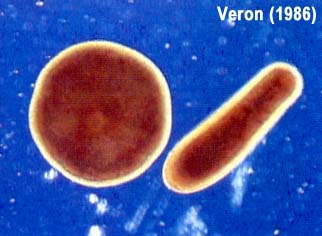
If eggs do not contain zooxanthellae, then the fertilized egg (a "zygote" which has divided multiple times to become a planula larva) must acquire them from the environment. This provides our best indirect evidence that zooxanthellae have an independent existence outside of their marine invertebrate hosts. Exactly how these free-living zooxanthellae are picked up is not known. Since the density of zooxanthellae in the water column is likely to be low, chemotaxis (greek: "chemical movement") may be involved. Or maybe the free-living zooxanthellae pursue a benthic (bottom-dwelling) existence, and are able to crawl to their new homes. We simply do not know. However, it seems fair to assume that this "open" symbiosis (with an "indirect", "environmental" or "horizontal" means of symbiont transmission) opens the door for the acquisition of types of zooxanthellae not previously contained by the mother colony.
A critical gap in our understanding of the natural history of coral-algal symbiosis is our ignorance of whether adult coral colonies (as opposed to just "baby" planula larvae) can acquire free-living zooxanthellae from the environment. If this is the case, we might expect a shifting population of zooxanthellae in the coral host that is continually being interchanged with the surrounding seawater. Some workers have suggested that coral "bleaching" may provide an opportunity for adult corals to exchange zooxanthellae with the environment. In fact, it seems likely that "bleaching" is a continuous process that is merely more apparent during times of environmental stress. Low level expulsion of symbionts may occur on a relatively regular basis, allowing for the continual turnover of symbiont populations in the coral host.