Introduction to Europe Since 1945
Course Information
HIST W3303.001 EUROPE SINCE 1945
MW 2:40-3:55 pm 209 Havemeyer Hall
Instructor Information
VICTORIA DE GRAZIA
PROFESSOR OF HISTORY
Office Address: 617 Fayerweather Hall
Telephone Number: 854-3667
Fax Number: 932-0602
Prof. de Grazia's homepage
E-mail:[email protected]
Office Hours: Wednesdays 12:30 - 2:00, and by appointment
Office Location: 617 Fayerweather
TA Information
Giuliana Chamedes [email protected] |
Film Series
Time: Selected Monday evenings 7:30pm - 9:30pm
Place: Havemeyer 209
Schedule of Films
Course Description
This course explores major trends in the history of Europe since 1945. Starting with the study of old Europe’s defeat under the Nazi-led New Order the course traces the new Europe’s emergence as the prosperous cross-roads of three continents and the region of the world most explicitly committed to overcoming its past divisions.
Marvelously diverse, with fluid boundaries and so much history compacted into such a small area, Europe has long been an arena of complication and contentiousness. Europe’s major problem since 1945, as in earlier time periods, has been to enable culturally and ethnically diverse peoples to live side by side while reconciling the interests of unevenly-endowed often competitive states, each in turn fraught with internal social conflicts. This course highlights the nature of these differences and the novel institutions and policies devised to hold them in check in the wake of the catastrophe of World War II. At every moment of significant change, Europeans, at the same time as they have had to confront new challenges, have also had to address a heavy legacy of division and conflict.
Organization of the Course
Class activities, readings, and assignments are organized according to four major turning points:
Part I: 1945-1956
Beautiful Dresden, 1930
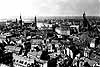
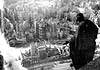
Bombed-out Dresden, 1945
Part I, Years of Recovery, 1945-1956
sets the rebuilding after World War II against the background of Europe's catastrophic decline in two world wars. Here we explore the legacy of Hitler's New Order and the new international framework established by the Superpowers-the U.S.A. and the USSR -- within which Europeans had to sort out their conflicts. This section highlights the distancing of western from eastern Europe and western Europe's new relationship to its former colonies during the Cold War. In particular, we follow how western Europe was unified in the 1950s by the Common Market, centrist political systems, and American-style mass consumption, while east-central Europe was modernized under one-party political systems, more and more closely tied to the USSR, using Soviet-type economic plans, and emphasizing egalitarian reforms. The section ends by focusing on the engagement of intellectuals in making sense of the war and the Resistance.
Part II: 1956-1973
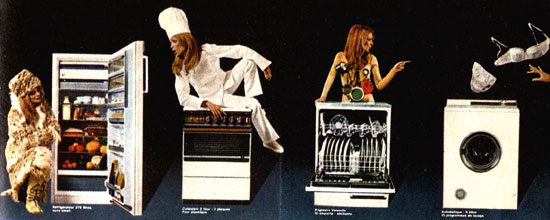
Consumer Affluence
Part II, Years of Movement, 1956-1973, moves us into the decades of great transformation under the impact of rapid economic growth. This occurred simultaneously, if very differently, in western and eastern Europe. In the 1950s and the 1960s, we observe significant change in every aspect of life from occupational structure and class stratification to new ethnic diversity, sexual customs and shopping habits. The 1960s, in particular, were anxious and exciting times as Europeans turned their back on the past, alternately glorying in, chafing at, and rebelling against their new prosperity. The section ends by analyzing the mix of old and new in the so-called movements of 1968 cutting across all of Europe.
Part III: 1973-1989

Out of Gas
Part III, Years of Disorientation 1973-1989, highlights the disorientation Europeans experienced with the end of the post-war boom in the 1970s and the onset of a new period of global economic change. Here we examine how
European countries diverged as they experimented with new political solutions in an effort to adjust: in northern Europe, neo-liberalism, in southern Europe social democracy and parliamentary liberalism, in eastern Europe, so-called goulash socialism. We can also see strains, evidenced in growing animosity toward outsiders, post-modern critiques of European radical traditions, and cultural battles over how to interpret the past. In eastern Europe, these strains lie behind the break down of the Soviet bloc.
Part IV: 1989-2005
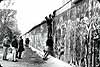
Tearing down walls
Part IV, 1989-2005, Years of Redefinition
looks at the Europeans after the end of the Cold War as they have sought new ways to relate to each other and to a rapidly globalizing world. Building the post-post War Europe has involved deepening and widening the institutions of the European Union. It has also called for new ways of thinking about who is a European and how to integrate old minorities and new waves of immigrants new minorities. Not least, it has brought Europeans to reflect once more upon their past, not only the Nazi-fascist period and the legacy of communism, but also Europe's relations globally, especially with the United States.
Course Requirements
Completion of all assigned readings.
Viewing at least 5 of the films shown on selected Monday evenings from 7:30 to 9:30. These films are also available for viewing in Butler library media reserves.
Two map quizzes (5% each of final grade).
Participation in the biweekly discussion sections (10% of final grade) .
One in-class midterm exam, March 8 (20% of final grade) .
One 10-12 page essay which could focus on a set of the films, a comparison of city histories or memoirs, or a research paper on an issue pertinent to the themes raised in the class. Paper topics are due March 29, to be approved by your TA. Final draft of the paper is due April 21 (30% of final grade) .
One final examination during the regular exam period based on questions prepared in advance (30% of final grade) .
Books
On order at Labyrinth Book Store at 536 West 112th Street.
Required:
Francoise Gaspard, A Small City in France
Jana Hensel, After the Wall: Confessions from an East German Childhood and the Life that Came Next
Tony Judt, Postwar
Steven Kotkin, Steeltown USSR: Soviet Society in the Gorbachev Era
Primo Levi, The Reawakening
Recommended:
Victoria de Grazia, Irresistible Empire
Course books are also on reserve in the College Library Reading Room and at Barnard Reserve. The films are on reserve in the Butler Library Media Room.
Lecture and Reading Schedule
Reading assignments from the books, as well as some additional readings from selected documents are to be found under each lecture topic in the Course Works. Try to keep up with the reading, and make sure you finish it by the time of your discussion section.
Discussion Sections
Discussion sections will be assigned the week of January 23.