 |
|
|
|
|
|
|
|
|
|
|
|
|
Auditory
System: Speech Areas
|
|
|
|
|
 |
|
|
|
 |
|
|
|
|
|
|
|
|
|
|
|
|
| • |
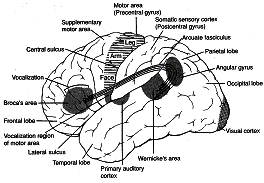
Classical
division on basis of
|
|
aphasia
following lesions:
|
|
|
|
– |
Broca’s
area: understand
|
|
|
language
but unable to speak
|
|
|
or write
|
|
|
|
– |
Wernicke’s
area: speaks but
|
|
|
cannot
understand
|
|
|
|
|
|
|
|
|
|
|
|
|
|
|
|
|
|
|
| • |
Current
understanding: not uniform areas. Rather,
|
|
|
category-specific
with strongest activation proximal to the
|
|
|
sensory
or motor area associated with that category:
|
|
|
|
– |
Words
for manipulable objects (tools) activate reaching / grasping
|
|
|
motor areas
|
|
|
|
– |
Words
for movement activate next to visual motion areas
|
|
|
|
– |
Words
for complex objects (faces) activate visual recognition areas
|
|
|
|
|
Ref: fMRI of
language: Susan Bookheimer, Ann. Rev. Neurosci. 25:151-88,
2002
|
|
|
|