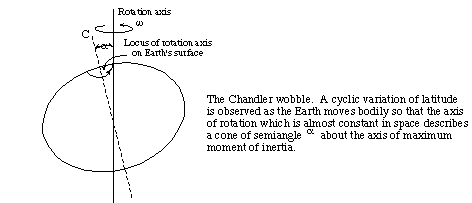
Figure 2.3.1
Introduction to Earth Sciences I
2.3 Another regular motion - Chandler Wobble
In addition to the three large scale motions we have discussed, the Earth experiences a nodding (or nutation) called Chandler Wobble. This results because the Earth is not rotating about its axis of figure, or axis of maximum moment of inertia. The point on the Earth's surface where the rotational axis intersects, revolves around the axis of figure in yet another periodic motion, although, as can be seen from the attached map, it has a random component overprinting a regular rotation.
Figure 2.3.1
The period of the nodding can be deduced and it should be no surprise that it too is related to differences in the Earth's moments of inertia C-A. If the Earth were a purely rigid solid the Chandler period would be 305 days, but the observed period is over 400 (430).
The slower period is due to the fact that the Earth actually yields a little to gravitational torques because it is not a purely rigid solid.
Causes of the exciting and damping of Chandler wobble have been debated for many yields. Damping may be due to motion in the fluid core, but the reason the motion does not eventually evolve toward a rotational axis coinciding with the axis of figure is not known. Something always excites the motion by kicking the rotational axis away from the axis of symmetry.
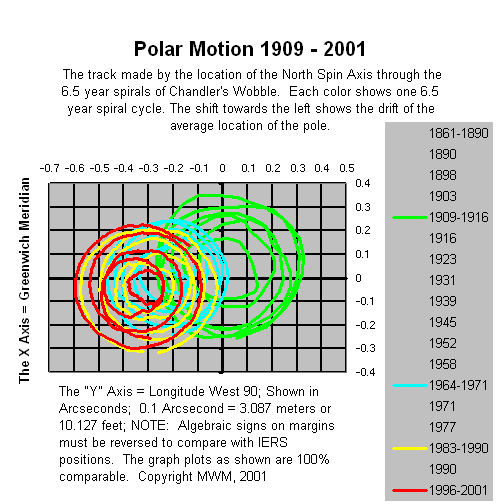
Figure 2.3.2
A more detailed description of the Chandler Wobble and its history
can be found at
http://www.michaelmandeville.com/earthmonitor/polarmotion/plots/chandler_wobble_plots.htm.