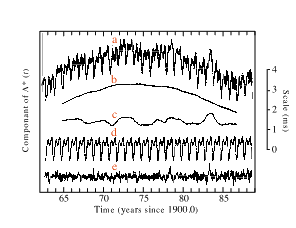
Figure 2.5.1
Introduction to Earth Sciences I
2.5 Length of Day Variations.
While it might seem fairly incredible that the length of the day is changing all the time -- not by an amount that anyone would notice, but by amounts that are easy to detect instrumentally. The changes are only a few milliseconds (a millisecond is one thousandth of a second) but they are very easy to measure. The record below shows that there are very regular variations and also very irregular variations. All of the changes must in some way be caused by the re-distribution of mass over the surface and with in the Earth. Seasonal changes (curve d) are caused by the change in ice volume and relative amounts of water in the atmosphere from summer to winter. Longer period changes and shorter period changes (curves c and e respectively) are more difficult to explain. Some are caused by the phase of the El Nino -- the Earth rotates differently in an El Nino year than in a La Nina year because these phenomena change the distribution of wet and dry parts of the world. Even longer period changes must be caused by processes in the deep Earth that move masses around such as subduction of large slabs of lithosphere. The cause of many of the longer period signals is not well understood.
Figure 2.5.1