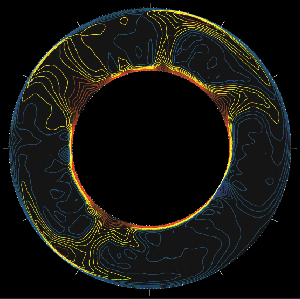
Figure 3.3.1 Burkavici(sp?)
Introduction to Earth Sciences I
3.3 "Real" Mantle convection and its surface manifestation - Plate Tectonics
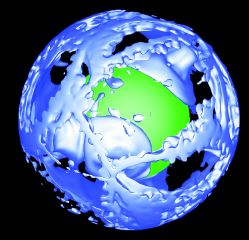
To make matters more complicated the mantle is convecting in a spherical shell between the core, which supplies heat from below, and the surface where cooling takes place, and has internal sources from radiogenic heat production. It has taken many years to produce computer simulations for realistic Earth models and the one shown below is one of the first. Hot areas are yellow, cooler areas are blue.
The two still images were both made as full spherical shell
calculations. The one on the left was created by Burkavici, and the one
on the right by Paul Tackley. Burkavici was one of the first to carry out this
complicated calculation. We see areas of rising material in warm colors
and sinking material in colder blue colors. Tackley’s 3D rendering
shows the core (the source of heat) in green and only the downwelling parts
of the system are shown (in blue). This is a common way to represent the
system as showing all the components can be quite complicated.
Figure 3.3.1 Burkavici(sp?) |
|
|
|
|
Tackley’s image is a still from a “movie” that shows mantle flow in a 3D Earth at http://artemis.ess.ucla.edu/%7Epjt/images_etc/f_avalanches.mov. A similar movie showing the upwelling components is seen at http://artemis.ess.ucla.edu/%7Epjt/images_etc/f_bh_3dsph.mov.
These calculations are for a fixed Rayleigh number and assume that the entire mantle has the same properties. This is almost certainly not the case. The mantle has several discontinuities or boundaries that can be detected by seismic methods (see Topic 4) and probably correspond to chemical phase changes where the atoms of mantle compounds get re-arranged under pressure and transform to different material with different properties. Many researchers have argued that the upper mantle (shallower than 670 km) will behave quite differently from the lower mantle. In addition, as well as boundaries we might expect the mantle’s properties to gradually change with depth under changing pressure (which leads to density changes) and temperature. If these lead to changes in viscosity (as we might expect) then the Rayleigh number will gradually change from the top of the mantle to the bottom and we might expect the style of convection to change from top to bottom. The two movies at
http://artemis.ess.ucla.edu/%7Epjt/images_etc/pldemo1.mov and http://artemis.ess.ucla.edu/%7Epjt/images_etc/pldemo2.mov illustrate this. They both show a “mantle plume” rising from the core and impinging on the base of the lithosphere at the surface, one under constant viscosity assumptions, the other assuming a temperature-dependent viscosity.
These plumes are very important features of the mantle.
Modeling suggests that they may remain remarkably in tact as they traverse the
mantle from core to the surface. The animations below are simulations
of mantle convection made by Marylee Murphy with three different whole mantle
Rayleigh numbers (noted in the top left). Note the thin upwelling plumes
and how they seem to wave around in the “mantle wind” cause by larger
scale flow. The plumes have mushroom heads, a typical feature of rising
energy very familiar to us in the images of the clouds from nuclear explosions.
It is essentially the same phenomenon.
Figure 3.3.3: Ra = 3 x 10⁷
Figure 3.3.4: Ra = 3 x 10⁸
Figure 3.3.5: Ra = 109
Convection is a very efficient way of transporting heat. In general, unless heat is continuously supplied, Raleigh numbers will decrease in a convecting fluid and convection will stop. Any remaining heat will be transported by conduction. The evolution of the Earth's Raleigh number is not well known but it is apparent that the mantle has been in motion for at least the last several hundred million years, perhaps a great deal longer. Typically, the upper surface of a convecting fluid will freeze because it is most directly in contact with the low temperatures area. In some instances a solid surface layer will form and convection may continue beneath with little external evidence that it is taking place. In most cases a frozen or semi-frozen layer will form and be carried along by the upper part of the flow. The frozen layer will typically break up into a number of large pieces that move somewhat independently, collide and bump around on the top of the moving fluid. Sometimes they get sucked back down into the convecting region and re-melt. This is the upper thermal boundary layer of convection. In the Earth the lithosphere is the thermal boundary layer and its large pieces are the plates of plate tectonics. Creation and movement of the thermal boundary layer, their collisions and other interactions are what we mean by plate tectonics.
The above statement must be taken as a very first order approximation. In particular, it is not correct to assume that the upwelling limbs of a convection cell correspond to places where new lithosphere is created and that downwelling corresponds to subduction zones (even though most undergraduate text books continue to show just that). It has proven extremely difficult to create computer models that include the thermal boundary layer and simulate even very basic features of plate tectonics. Plates come in many sizes and their complex motions cannot be simply seen as a direct response to mantle flow patterns. It is also likely that lithosphere and aesthonosphere are largely decoupled so that mantle material can effectively slip along under the lithosphere. Most importantly, the lithosphere itself cannot be seen as a passive passenger rafted along by mantle motions. It appears to be an active participant in plate tectonics, responding to gravitational forces associated with its variable elevation. Once a part of the lithosphere begins to subduct it will be pulled down under its own weight. It is not forced down into the mantle but falls under its own weight.
Plate tectonics is a complex interplay between forces generated by flow the mantle, of which the lithospheric plates are the upper thermal boundary layer which is generally rigid, and forces generated within the plates themselves.
3.3.1 Some Plate Tectonic Basics
The Earth exhibits plate tectonics as the surface manifestation of deep processes within the Earth. Plate tectonics is also, to first order, why the Earth looks the way it does. Why we have mountains, and why we have them where they occur, why earthquakes occur where they do, why oceans are different from continents, why volcanos occur where they do and why their lava has the chemical composition that it does. Plate tectonics is the great unifying theory of Earth sciences of the second half of the 20th century. Much has been written about the subject, and there are a huge number of Web sites with information on the subject also. Our perspective in this part of the Introduction to Earth Sciences course was to obtain a basic understanding of why plate tectonics occurs. In the part of the course that Prof Langmuir covers you will learn a great deal more about the expressions of plate tectonics, focusing more on the chemical aspects of these processes. One useful Web site is:
www.sprl.umich.edu/GCL/Notes-1999-Fall/Earth/evolving_earth.html
It gives a fairly complete outline of the basic principals and is reasonably well illustrated. There is also a much more elementary site at
www.enchantedlearning.com/subjects/astronomy/planets/earth/Continents.shtml
that is meant for pre-college students but you might want to go to get started
if some of the concepts are really very unfamiliar.
This animation in Figure 6 from the first site shows the familiar continents
in unfamiliar locations.
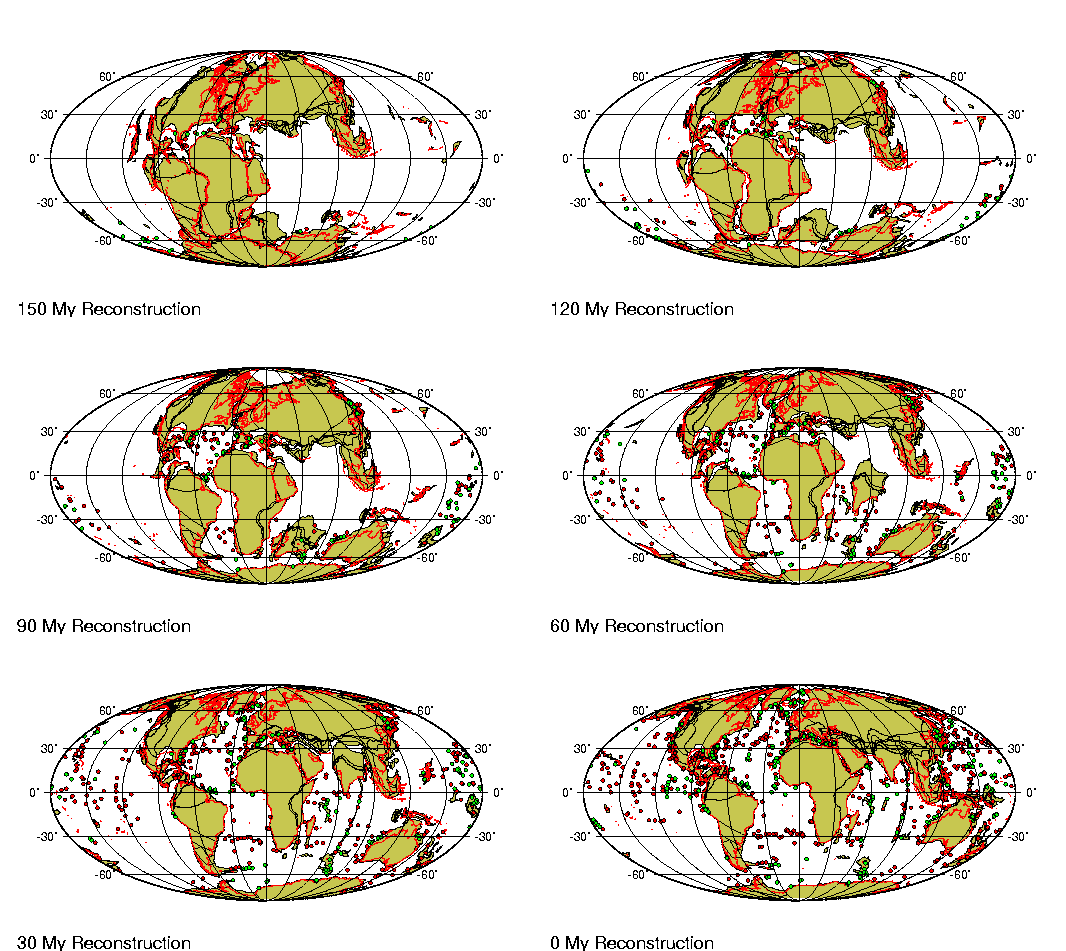
Figure 3.3.6
Beginning at 150 million years ago (see the counter in the
lower left) it shows how the continents have moved about the face of the Earth.
Prior to 100 million years ago Africa and South America were joined, as was Europe
and North America forming a much large continent. Australia and Antarctica were
also joined. Thus, prior to about 100 million years ago there were fewer, larger
continents on the globe. The animations shows them break apart and move around
in what was originally described as Continental Drift as early as the 1930's.
As the continents move they sometimes collide - note how India moves north away
from Antarctica and collides with Asia about 30 million years ago. This collision
is responsible for the creation of the Himalayan Mountains and the Tibetan Plateau.
Evidence for continental drift is now overwhelming although it was deeply contested
until about the 1960's.
Its not difficult to imagine, seeing the continents move about the surface of
the globe and recalling the results of convection simulations like those shown
above that these two phenomenon are intimately connected. But something is missing
in the picture of continental drift. Figure 6 has a huge amount of white space.
What is happening in those areas.? The answer is shown in Figure 2 from the
Web site.
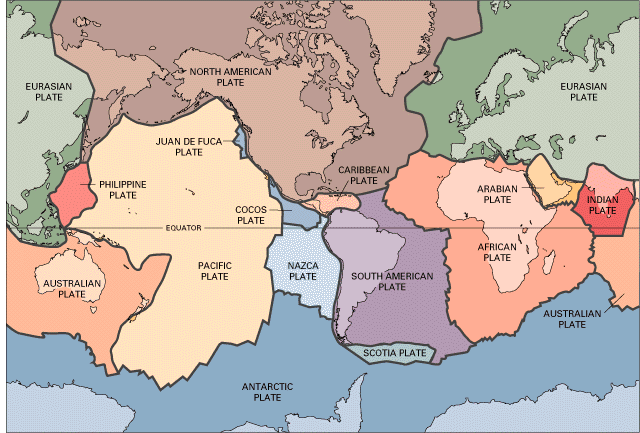
Figure 3.3.7
What you see is the face of the globe divided up into lithospheric plates within which the continents are incorporated. Plate boundaries are shown as heavy dark lines. It is really these plates that are in motion as the thermal boundary layer of mantle convection and they carry the continents with them. What we recognize as continental drift is a direct consequence of plate motions. In fact, Plate Tectonics is what explains why the continents appear to drift.
The plates are internally rigid and as the plates move about they interact at
their boundaries - they have to! If the Earth is not expanding (and its not)
then plates must sometimes approach each other across a boundary, and oppositely
they must move away from one another at other boundaries. In fact, on a finite
sized Earth, plates must move away from one another just as much as they move
toward one another. The other motion that can take place is a simple sliding
by one another. The three types of boundaries are very distinct in their physical
manifestation, structure, volcanic properties and type of siesmicity (the earthquakes
they produce, as we will discuss in Topic 4). Characteristics of the different
boundaries will be discussed by Prof Langmuir in his lectures.
For now we need to recognize that the boundaries where plates come together
are places where a process called subduction takes place in which one of the
two converging plates actually slides beneath the other and returns to the mantle
where it is re-assimilated back into the deep Earth. As it does so it expels
water into the overlying mantle, causing that area of mantle above the descending
plate to melt a little and the resulting volcanism at the surface builds volcanic
chains like the Andes of South America and the Aleutian Islands of Alaska. Some
of the world's most destructive volcanos and the world's largest earthquakes
occur at these places. Mt Saint Helens is one such volcano. Where the plates
subduct the floor of the ocean deepens dramatically. The very deepest parts
of the world's oceans are associated with plate convergence at subduction zones.
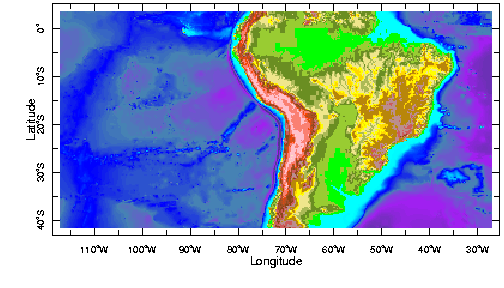
Figure 3.3.8
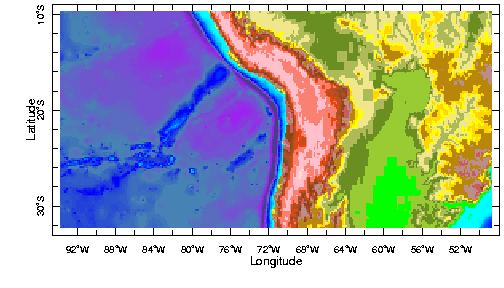
Figure 3.3.9
The boundaries where plates move apart give rise to the world encircling system
of mid-ocean ridges, or so-called spreading centers. As plates move apart the
mantle beneath moves upward to fill the space (there cannot be a gap). In moving
upward the mantle melts a small amount as it looses pressure - a process akin
to the way water will boil at lower temperature at higher elevations. The melt
is a magma that rises to the surface where it solidifies to form the crust of
the ocean floor. At the same time the upper layers of the mantle cool to form
the plate itself that comprises not only the crust but the rigid lithosphere
beneath. The region is called a divergent plate boundary and it is where new
crust and lithosphere are created. The dual processes of subduction at convergent
boundaries and creation at divergent boundary describe the life cycle of the
lithosphere. The figure below shows the structure of the mid-Atlantic Ridge
in the North Atlantic ocean.
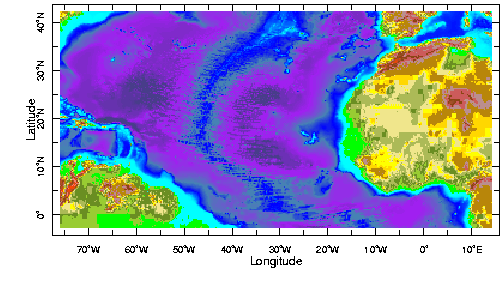
Figure 3.3.10
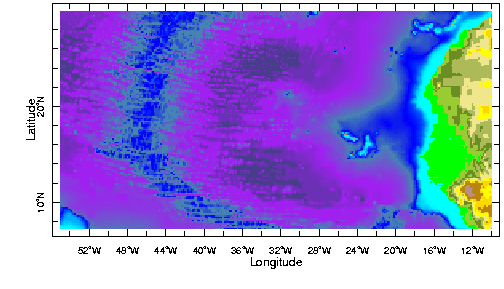
Figure 3.3.11
The Mid-Atlantic Ridge is the elevated region almost exactly in the middle of
the ocean. You can also see that the crest of the ridge isn't completely continuous;
it is broken in many places by discontinuities that form clear almost linear
features that run nearly east-west across the ocean. These are the places where
plates slide past one another and are called transform boundaries. All three
types of these boundaries are active on the earth all the time. They are the
focus of almost all the world's earthquakes (see Figure 1 from the site) and
much of the volcanism, both of which are prime indicators of tectonic activity.
The two animations shown below show the plate tectonic evolution of the eastern
Pacific from an excellent site created by Tanya Atwater at UC Santa Barbara.
The spreading center in this case is known as the East Pacific Rise and it runs
approximately almost NNW-SSE (a bit inclined over to the west from north-south).
It process new lithosphere in a roughly east-west sense, both to the east and
to the west of the spreading center. Seafloor spreading is typically almost
symmetric, producing new material equally on both sides of a mid-ocean ridge.
To illustrate the creation of new crust over time lines are drawn as if they
were marked on the floor of the ocean at particular times. These are called
isochrones. So for instance, imagine that just as the crust was being produced
at the East Pacific Rise 50 million years ago we painted a heavy line on the
ocean bottom. That line would progressively move away from the Rise as new crust
is produced. Several such isochrones are illustrated and can be used to chart
the growth of the ocean floor. Clearly seen also are the transform boundaries
that appear more or less east-west in orientation and separate distinct bands
of crust.
Plate Tectonic Evolution Animation
For illustrative purposes only North America is held fixed in the animation. In fact, North America also moves. We see the lithosphere created at the East Pacific Rise disappear under North America at a convergent boundary and when the Rise itself intersects the convergent boundary there is a reaction that re-orients the spreading center and causes the transform direction to become nearly parallel to the coastline. When this happens the transform motion intersects the edge of the continent and slices off pieces of the edge. The great San Andreas fault is part of this motion and Baja California is a sliced off piece. The effect of transform motions on the western margin of North America is illustrated in the second animation below.
The tectonic plate configuration of the globe has been in constant evolution
for at least 200 million years are probably much longer. Continents have been
broken up many times and new oceans formed throughout. Chris Scotese at UT Arlington
has charted all these motions in a major project available at http://www.scotese.com/earth.htm.
This site allows you to pick a certain time period and see how plate motions
evolved during that period of time. Several other sites allow for this type
of reconstruction.
To Topic 1 / To Topic 2 / To Topic 4 / To Topic 5