Introduction to Earth Sciences I
5.6 Dynamical Systems
What we have been studying is a class of system known as
a dynamical system. There are a variety of interesting tools we can use
to study these systems. We have already seen an example in the forced,
damped pendulum. Let's try to analyze the pendulum system to see if we can
learn a little more about it.
Our previous description of pendulum motion showed two
representations
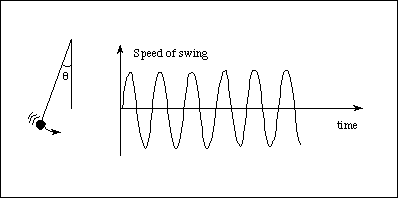
Figure 5.6.1
For a frictionless (undamped) pendulum in a vacuum the
motion in phase space is a circle. This is a more compact representation
in which speed and position are plotted on orthogonal axes and the motion
is tracked in time as position in this new space. Pendulums whose swing
begins at a greater distance has a large diameter circle.
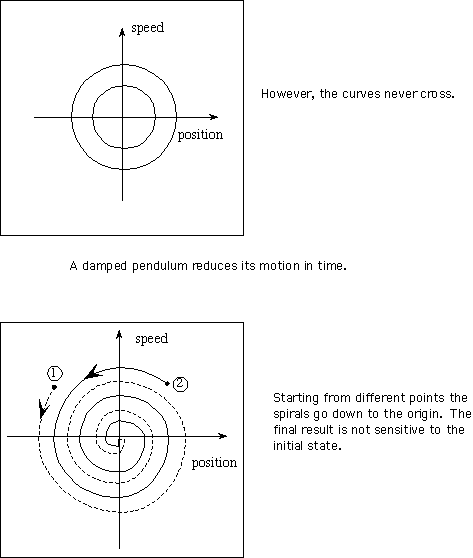
Figure 5.6.2
In time series these look like
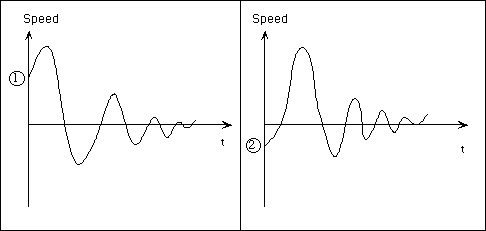
Figure 5.6.3
A forced, damped pendulum for which the forcing just matches
the damping the orbit in phase space will be approximately circular like
a frictionless pendulum in a vacuum.
If we gradually change the forcing (the parent slowly gets
out of sync with the child in the swing) the orbit in phase space will distort.
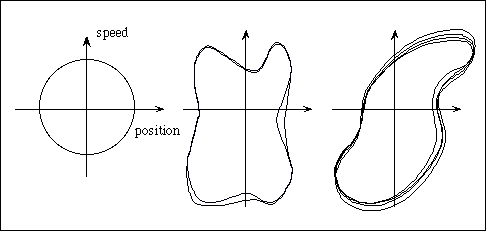
Figure 5.6.4
However, all other factors being equal, the orbit in phase
space will perfectly repeat, at least for awhile.
Now, as the synchronization decreases the orbits are no
longer predictable because the motion is no longer predictable, just as
we saw in the time series.
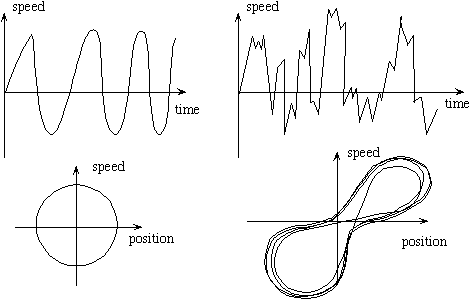
Figure 5.6.5
What is shown is the very typical structure of the phase
space of a chaotic process.
Note that the phase space representation does not appear
entirely chaotic - there are two regions about which the orbits tend to
oscillate. These are known as attractors. Simple, deterministic, processes
exhibit simple forms while chaotic processes tend to have more complex patterns
and the attractors are called "strange" attractors. What they
are telling us is that inside, embedded within the unpredictable nature
of the chaotic phenomenon, there is indeed a uniform component.
Strange attractors were first recognized by Edward Lorentz
in 1961 in an attempt to understand why he was unable to predict climate.
He greatly simplified the very complex differential equations that describe
heat exchange and flow of gasses in the atmosphere into three linear equations,
coded them into a computer and simulated a changing climate by letting the
model run awhile. This was really the first computer simulation of climate
- a field that is now huge and is the standard way that forecasts are made
both for local weather and the climate. What Lorenz found when he did these
runs was an extreme sensitivity to where he started the run - a sunny day
in July or a dull day in September.
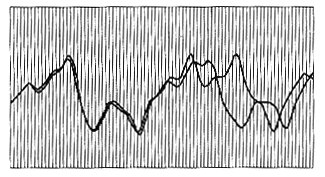
Figure 5.6.6
He found a major divergence in the model runs suggesting
an extreme sensitivity to initial conditions. It was the first time a chaotic
system had been observed.
How does this thinking apply to understanding the Earth and
particularly issues of predictability of Earth systems? Remember
how the time series of the Earth's temperature history that derived
from ice cores appeared.

Figure 5.6.7
It looks oscillatory; flip-flopping back
and forth between one state and another. Something looks sort of
systematic in there but its hard to quite get it out of an
examination of the record alone. Scientists often gain insight into
the very complex systems by calling on very simple systems as crude
analogies. No-one tries to suggest that they are exact
representations of the world but we hope that they might capture some
of the essential ingredients of the earth's behavior. The Web site
http://www.apmaths.uwo.ca/~bfraser/version1/index.html
has a number of interesting examples. One is the double well oscillator that is a
crude way of showing how a simple system driven externally by
rhythmic forcing (like the child on the swing) can exhibit very
complex behavior. In this case, the two "wells" are actually magnets
and what we see is an unpredictable swinging back and forth between
two stable states. These could be something like the the two major
climate states - glacial and inter-glacial. We tend to find that the
earth has been in one of these sites or the other and that there
isn't a real in-between state. This is called bi-stable. It is
quite common. Remember that the Earth's magnetic field is either
north pointing or south pointing; never in between (for any length of
time). The same is true of short-term climate. We have an El Nino
or a La Nina, the warm and cold phases of ENSO - the El Nino Southern
Oscillation. There is a neutral state so maybe we should say it is
tri-stable. The proper term is meta-stable meaning that it has
several stable states with unstable transitions between. As more and
more of the past history of the Earth becomes available through data
such as that from ice cores, we increasingly see evidence for
meta-stable behavior of the Earth, particularly its climate and
oceanographic systems.
Lorentz's water wheel found under Lorentz Equation at
http://www.apmaths.uwo.ca/~bfraser/version1/chaos.html is another
example of how unpredictable behavior can emerge from simple systems.
In a way it is like the sandpile in that the driver stays the same -
just an input of water into the buckets on the wheel, but the systems
can move from regular to irregular for a very small change in the
driver - a little more water into the buckets and chaos begins.
Both the sandpile and the water wheel may in a crude way simulate how
earthquakes behave. We see that the size-magnitude relationship of
earthquakes is the same form as the size of avalanches in the
sandpile. We also know that the plate tectonic drivers of
earthquakes are steady while earthquakes are the non-steady
"response" to this steady forcing.
These very crude model systems - sandpiles, water wheels, double
wells - with remarkably uniform drivers are able to display very
complex behaviors, not unlike the behavior we see in many Earth
systems. If they can be seen as teaching us about the underlying
nature of Earth systems what they say is that our ability to predict
is inherently limited. It is not a matter of lack of understanding
of the system that limits our ability to predict their future
behavior, it is that we understand them to be non-linear in nature
and hence display chaotic characteristics that will limit their
predictability to relatively short durations.
Click on this link for slides from Brad Lyon's lecture:
http://iri.columbia.edu/~blyon/class1.html
Topic 1
/ Topic 2
/ Topic 3
/ Topic 5