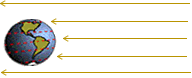
Figure 1.1.1
Introduction to Earth Sciences I
1.1 The Earth's Size and Shape
Centuries ago people had very little idea about the total size of the Earth and hardly any notion of its shape. Few people traveled very far because transportation was difficult. So the total size of the Earth became an early object of inquiry.
One of the earliest attempts to estimate the Earth's size was done by Erastosthenes about 200 B.C. His deduction was based on a curious observation (his data) that intrigued him. He lived in Alexandria but had heard that in Syene, on the longest day of the year, the sun at midday shone directly down a well without making a shadow - meaning that it was absolutely overhead at that time. He also knew that this was not true on the same day in his hometown of Alexandria, and this puzzled him a lot. His deduction allowed the size of the Earth to be estimated.
Figure 1.1.1
If the Earth were flat the "sun angle" would be the same everywhere. The sun is so far from the earth that the light "rays" from the sun are more or less parallel
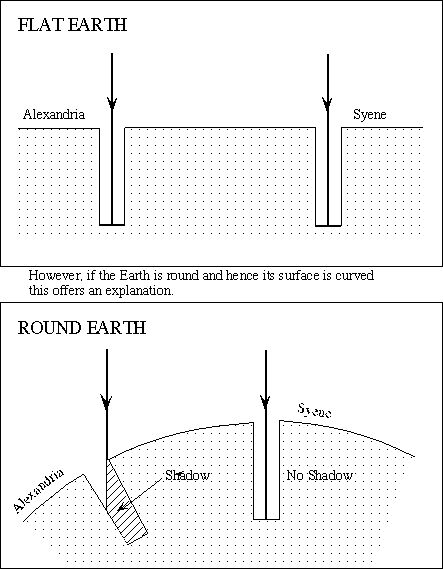
Figure 1.1.2
If the Earth is round then the "sun angle" would change and he reasoned that the amount of sun angle change had to have something to do with the Earth's total size. Apparently the idea that the Earth is round (spherical) was know at this time, well before Europeans made the same deduction. If it is round it has a radius and he knew how to find its radius because he knew geometry from Phythagoras.
Because of this he knew about angles. At that time the concept of "angle" was still new and it was cast in terms of ratios in two different ways.
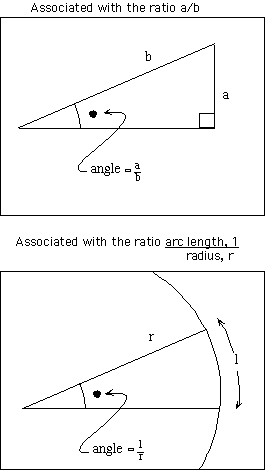
Figure 1.1.3
Eratosthenes measured the sun angle on the longest day at midday using the shadow cast by a vertical stick -- a triangle made by a vertical stick in the ground and the length of the shadow it cast.
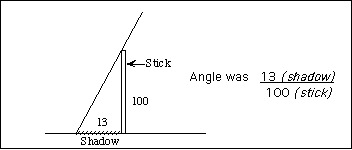
Figure 1.1.4
Eratosthenes used his knowledge of elementary geometry and reasoned that the angle made by the stick's shadow was the same angle as that made by the arc length from Syene to Alexandria and he knew the distance from Syene to Alexandria.
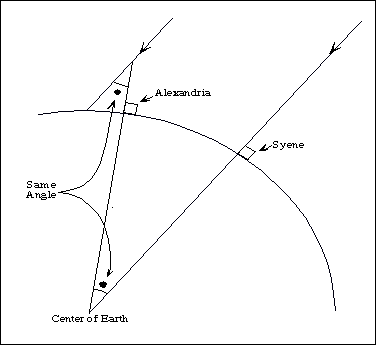
Figure 1.1.5
From there he could get the circumference of the Earth which he estimated at 24,500 miles, only about 50 miles off current best estimate. By dividing the angle he deduced what fraction of the circumference was represented by the distance between Syene and Alexandria. Other descriptions of Eratosthenes' famous experiment can be found at http://www.algonet.se/~sirius/eaae/aol/market/collabor/erathost/ and http://share2.esd105.wednet.edu/jmcald/Aristarchus/eratosthenes.html.
Mini-Quiz:
Forward and Inverse Thinking
Relating what Erastosthenes did to the ideas in our opening comments, we would say that the data available to Erathosthenes was the curious observations of shadows in wells and sticks. He then used a theory of angles, to infer one of the Earth's critical parameters - its radius - which he could not measure directly.
Viewed as an inverse problem, the data and theory of angles were used to deduce an important size parameter.
Viewed as a forward problem, the radius parameter and theory can be used to explain the shadow problems.
Shape of the Earth
What Erastosthenes couldn't know is that the Earth is actually oblate; its equatorial radius being greater than the polar radius. This took many more years of very accurate geodetic measurements and the shape of the Earth has only been determined with any significant accuracy in the 20th century.
The Earth departs from a purely spherical shape in having an equatorial radius that is greater than its polar radius.
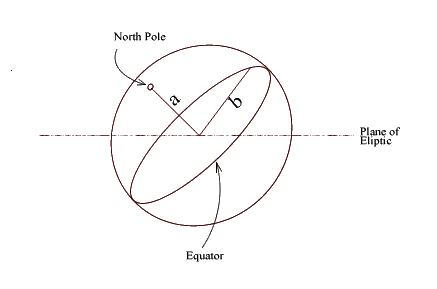
Figure 1.1.6

The same number for the Moon is about  . The Moon is more nearly
spherical. The oblate shape of the Earth is prima faci evidence that it is not
completely solid throughout. That it bulges at its equator suggests that it
must be somewhat liquid-like. If we were to spin a water-filled balloon on a
Potter's wheel it would bulge out - that's essentially what the Earth does.
If you were to spin a balloon at the same rate of spin, but filled with maple
syrup it would still bulge out but by a smaller amount. For any particular fluid
in the balloon, the faster you spun it the more it would bulge. Even a solid
sphere spun fast enough will budge a bit. Because the Moon does not do have
the same extent of bulge as the Earth suggests that it is more nearly solid.
In fact the Moon presents the same face to the Earth and is not rotating on
its axis like the Earth. The Moon's elliptically is a relic feature from a time
when it was less solid and rotating. Earth's elipticity is part relic, part
dynamic.
. The Moon is more nearly
spherical. The oblate shape of the Earth is prima faci evidence that it is not
completely solid throughout. That it bulges at its equator suggests that it
must be somewhat liquid-like. If we were to spin a water-filled balloon on a
Potter's wheel it would bulge out - that's essentially what the Earth does.
If you were to spin a balloon at the same rate of spin, but filled with maple
syrup it would still bulge out but by a smaller amount. For any particular fluid
in the balloon, the faster you spun it the more it would bulge. Even a solid
sphere spun fast enough will budge a bit. Because the Moon does not do have
the same extent of bulge as the Earth suggests that it is more nearly solid.
In fact the Moon presents the same face to the Earth and is not rotating on
its axis like the Earth. The Moon's elliptically is a relic feature from a time
when it was less solid and rotating. Earth's elipticity is part relic, part
dynamic.
This oblateness, combined with the inclination of the rotational axis with respect to the plane of the ecliptic (the plane that contains the Sun and in which most of the planets revolve around the Sun), governs much of the planetary dynamics as we will see later on in Topic 2 of these lectures.
The shape of the Earth is now known in great detail primarily from satellite observations. The Earth departs from spherical in many important ways and this results in the mass of the Earth being unevenly distributed. This too governs the planetary motion. Imagine how a basketball would spin in space if you glued a small weight on one part of the exterior. It would wobble as it spun. If the mass were moved around in a more uniform manner the period of rotation would change. We will learn about how the Earth rotates in the lectures under the second topic.
In fact, the Earth's period of rotation does change regularly by a few milliseconds (thousandths of a second). Accurate measurements of the length of the day (the rate of rotation) show that the rotation period changes with the seasons as water is redistributed over the Earth and the relative amounts of ice, water and water vapor varies. The effect of an El Nino can be seen in changes of the length of day. Human activity also changes the rotation period -- when the Three Gorges Dam in China is filled the change in length of day will discernible to a skilled amateur astronomer.
Mini-Quiz: