Introduction to Earth Sciences I
1.2 Mass of the Earth: Cavendish's Experiment to "Weigh the Earth"
The next thing is to try to find out how much the Earth might weigh. This is much more difficult, and requires a very cunning experiment.
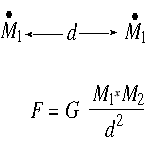
The first attempt to do this was made by Cavendish in 1798. Again the elements of theory, observation and deduced quantity are present. In this case we begin with Newton's universal law of gravitation which describes the force of attraction between two bodies having mass, and use the theory to set up an experiment that will allow the Earth's mass to be determined -
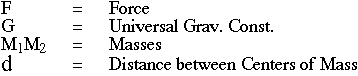
Even though the masses have real shapes, their attraction to one another would be the same as if all the mass were concentrated at a point -- the so-called "center of gravity" or "center of mass".
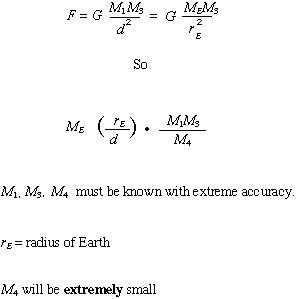
With this simple formula, Cavendish established the mass of the Earth using a very accurate balance beam by the following steps -

|
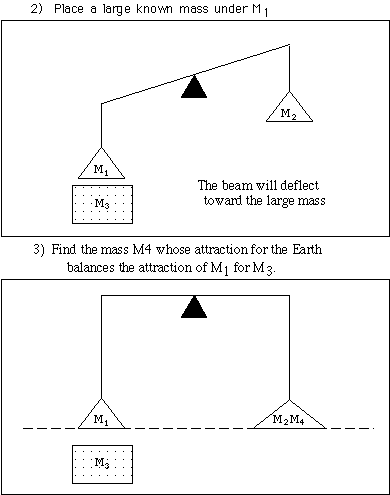
Figure 1.2.2


The exact density profile of the Earth is not well known, but the best estimates come from seismic studies. Seismic energy from earthquakes penetrates the whole Earth and allows us to determine the internal structure based on the speed of propagation of energy (we will deal with this in a later section). The speed of propagation is related to density in a regular way so that allows the density structure to be deduced.
Mini-Quiz:
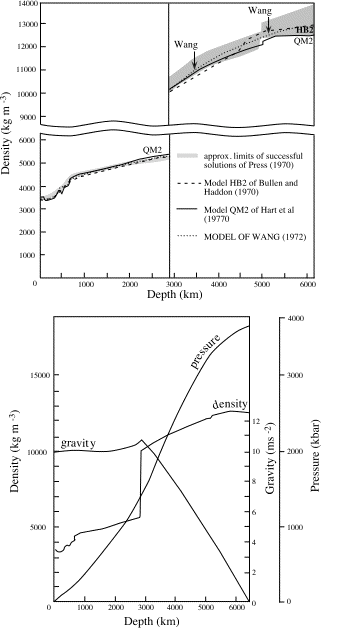
Figure 1.2.3
