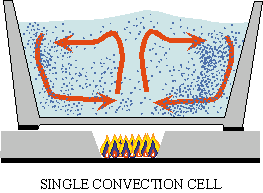
Figure 3.1.1
Introduction to Earth Sciences I
3.1 Heat transport: some basics
Heat is a form of energy and is transported through the Earth. In general the direction of heat flow is outward.
Heat energy is transported in the Earth by two primary mechanisms -
3.1.1 Convection in a little more detail
Convection takes place primarily because buoyancy forces are able to overcome viscous resistance. When a fluid in a container is heated from a central source below, it expands in the region of heating. In doing so it becomes less dense, and hence wants to move upward toward the surface. The surface above the heated region will also rise in response to expansion of the heated fluid. This lighter fluid that has risen to the surface will flow outward toward the edges of the container where it will encounter the cold edge of the container, cool down and, in doing so, become less dense and sink toward the bottom of the container. The collective effect is to set up a conveyer type motion with fluid rising in the center above the heated region, moving outward at the surface then down the sides. The overall effect is a circulation of material in two relatively simple cells, as illustrated in the cartoon below.
Figure 3.1.1

Figure 3.1.2
The animation above shows the result of a computer simulation of simple convection. The equations that govern convection (quite complex equations that we do not go into in class) are coded into a computer and the output is presented using computer graphics. Hot areas of the fluid are in reds and seem to rise, colder in blues seem to sink. You are watching a numerical simulation of convection in a computer. This is a very powerful way of learning about convection in the mantle since we cannot actually observe mantle convection.
It is relatively easy to see convection in a liquid and those taking the lab will do some experiments. Shown below is the result of an experiment in a real fluid. A tracer has been added and the fluid heated on the left hand side. The thin bands of the tracer show where the fluid is moving. You can see that in practice the flow is a little more complicated but, in general, it forms a circular pattern centered toward the left side.
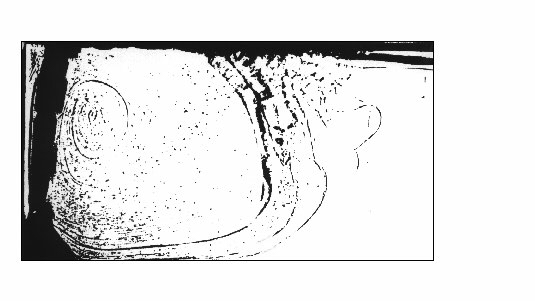
Figure 3.1.3
3.1.2 The Raleigh number - a fundamental quantity
The fundamental quantity known as the Raleigh number

describes the likelihood of a fluid to experience convective motion and the strength of that motion.
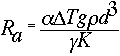
It is a ratio of the properties that give rise to convection verses those that oppose it.
The quantities on the numerator all encourage convection if they are large.
 - thermal expansion coefficient:
the more a fluid expands, the more it's density is lowered on heating and
the more it will want to rise.
- thermal expansion coefficient:
the more a fluid expands, the more it's density is lowered on heating and
the more it will want to rise.
 - acceleration due to gravity
&
- acceleration due to gravity
&  (fluid density)
both contribute because the weight of the fluid makes it want to sink.
 - height of the fluid in the convecting region
because the taller the column the more it rises for a given expansion coefficient.
- height of the fluid in the convecting region
because the taller the column the more it rises for a given expansion coefficient.
 - temperature gradient in
excess of the adiabat (see below for definition), because stronger thermal
gradients lead to more vigorous convection.
- temperature gradient in
excess of the adiabat (see below for definition), because stronger thermal
gradients lead to more vigorous convection.
In the denominator are quantities which, if large, inhibit convection.
 - thermal diffusivity describes the efficiency
of conduction. If the fluid diffuses [or conducts] heat very well it will
lose heat that way and will not want to convect.
- thermal diffusivity describes the efficiency
of conduction. If the fluid diffuses [or conducts] heat very well it will
lose heat that way and will not want to convect.
 - viscosity, because very
viscous fluids will resist convection.
- viscosity, because very
viscous fluids will resist convection.
It happens that when is ~2000
convection is possible. This is called the critical Rayleigh number.
is ~2000
convection is possible. This is called the critical Rayleigh number.
Another number that is commonly used is the Prandlt number, which is -

the ratio of viscosity to thermal diffusivity. All other things being equal this ratio must be very large for convection to take place.