Introduction to Earth Sciences I
3.2 Mantle convection
If  needs to be ~2000 for
convection to occur it is reasonable to ask whether the Earth's interior,
given what we have inferred about it in various ways from analysis of external
measurements, can convect heat and hence experience convective motion. The
answer is yes.
needs to be ~2000 for
convection to occur it is reasonable to ask whether the Earth's interior,
given what we have inferred about it in various ways from analysis of external
measurements, can convect heat and hence experience convective motion. The
answer is yes.
First, we know from our studies in Topics 1 and 2 that
the Earth is surprisingly soft in the interior. The mantle is best thought
of as a viscous fluid capable of flow - albeit very slowly. Thus, if the
Earth has a sufficiently strong temperature gradient, meaning that if it
is heated enough from below, and making a reasonable guess at the expansion
coefficient and diffusivity, convection should take place.
The two major sources of heat generation in the deep Earth
are the liquid outer core and radiogenic heat production in the mantle itself.
The mantle contains uranium, thorium and potassium, each of which is radiogenic
and produces heat as a by-product of radioactive decay. Many of these radiogenic
elements are extracted from the mantle during melting and reside in the
continental crust where they are in concentrations more than 200 times greater
than the mantle. Nevertheless, because of the great extent of the mantle,
its radiogenic heat production is very significant. The Earth's liquid outer
core is also a major contributor to heat production at the surface. The
exact temperature profile of the Earth is, of course, quite difficult to
determine and is generally inferred from melting experiments on materials
that we believe are present in the deep Earth. The illustration shows a
typical proposed temperature profile in the Earth which comprises three
main parts -

Figure 3.2.1
- The upper part shows a very steep gradient in the crust
where heat is transported mostly by conduction.
- Beneath that the gradient is much more shallow in the
mantle.
- A steep gradient between the lowermost mantle and outer
core.
Although fairly shallow, the mantle temperature gradient
is in excess of adiabatic - the temperature gradient that is due
only to the weight of the overlying material which will cause it to compress.
That is, the adiabat can be thought of as the temperature gradient due to
"self-compression" in the mantle. Because of radiogenic heat production
and heating from the core beneath, the mantle's temperature gradient is
super adiabatic.
Given this temperature profile and reasonable estimates
of the other physical quantities we can calculate an average value of Rayleigh
number for the mantle to be about 20,000 to 30,000, and hence we can expect
vigorous convection in the mantle.
Also, in the mantle the Prandlt number is about  and is as good as infinite for most purposes. So we really expect
that convection should be happening in the mantle.
and is as good as infinite for most purposes. So we really expect
that convection should be happening in the mantle.
Mantle convection is not simple. Because heating occurs
both from below and from within [core heat and radiogenic heat production]
and the heat sources are more uniformly distributed. When a heat source
is more distributed the convection often becomes multi-celled and a type
of convection known as Rayleigh-Bernard convection takes place.
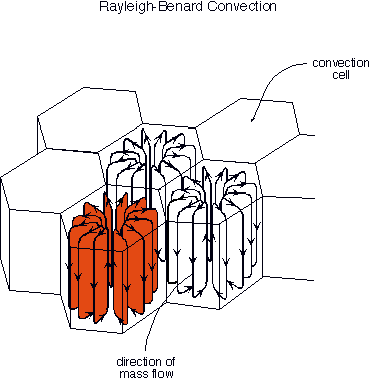
Figure 3.2.2
|

Figure 3.2.3
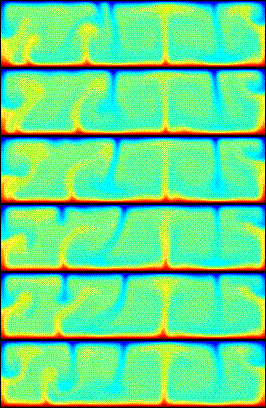
Figure 3.2.4
|
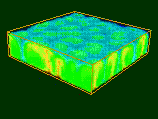
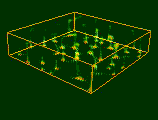
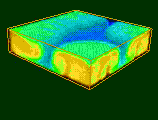
| These animations show numerical simulations of multi-celled convection.
The upper one takes a simple case and shows how the patter will break up
into several cells as convection evolves. The lower simulates a more complex(and
more realistic) case. The colors are as before (reds are hot, blues are
cool) and we see several centers of upwelling and downwelling and that
individual centers move laterally as convection evolves. |
Mpeg movies -- These should play with Windows Media Player
From: http://www.geof.ruu.nl/~trompert/html/mantle.html
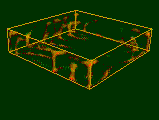
In fact, the actual patterns of flow may be more complex
still with sinuous patterns of fluid movement that migrate around throughout
the whole volume of the convecting region as this model shows.
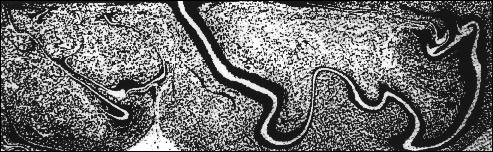
Figure 3.2.9
For an infinite Prandlt number, fluid at high Rayleigh numbers
convection becomes time dependent. That is, various cells of changing size
will form, stir the fluid for awhile and then disappear. The changing pattern
of convective cells in such a fluid cannot be predicted, and is certainly
associated with a non-linear behavior. Fluid flow becomes turbulent rather
than regular. Whether such a flow structure can be characterized as chaotic
is less clear. We know, however, that the behavior of the system is sensitive
to small changes in critical parameters like the Rayleigh number, and that
it will evolve from a simple state of single-celled convection to one of
multiple-celled convection then to a highly disordered state as such changes
occur. These are certainly aspects of behavior that are like chaotic systems.
Next