
Figure 5.2.1
Introduction to Earth Sciences I
5.2 Bak's Sandpile Experiment
The coastline problem is one of a class of problems that involve the
recognition of an ordered behavior within an apparently disordered
system. The classic problem was introduced by Per Bak and was
discussed in the very beginning of the course.
Bak made an apparatus in which he dripped sand at a regulated rate from a sort of sand faucet onto a circular plate. Initially, a simple sand pile is built up. The slope on the sides of the pile (called the angle of repose) can be used to estimate the coherence of the sand grains - stickier grains make steeper sand piles. The pile grows at a rate governed by how fast the sand is dripped out. At some point, however, the pile will always begin to collapse with addition of more sand, without changing the rate at which the sand is dripped from the faucet. Avalanches begin to form down the sides of the sand pile, as illustrated.
Figure 5.2.1

Figure 5.2.2
When avalanches begin the pile has reached a critical state in which it is beginning to fall apart. Many different sizes of avalanches occur even though there is no change in the sand dripping rate or any other aspect of the experiment. So the system's observable response is highly variable although the driving force doesn't change. Most important Bak observed that the
time, location and size of avalanches were unpredictable
What that meant is that studying any one avalanche, no matter how carefully, cannot enlighten us as to when, or where, or how large the next one will be. That is, reductionism (study of the unit components) fails to lead to an understanding of the dynamic behavior of the system as a whole. Studying an avalanche can lead to an understanding of the physics of avalanches (why any one occurs) but not to the dynamics of the sand pile.
How then can we learn about the system ? We need to observe the system in a different way. Instead of focusing in on the individual avalanches we need to assemble information on all the avalanches.
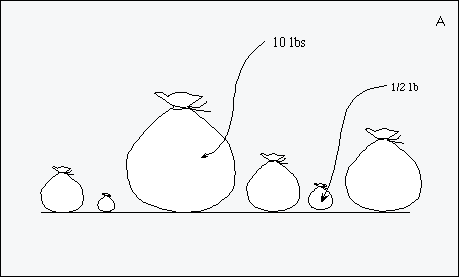
Figure 5.2.3
So we collect up the sand from each avalanche and put it in a bag. Some will be small, some big, some in-between. Then arrange them in order of size, and determine if there is any information in the ordering by making a simple graph of the incidence of bags of a particular size.
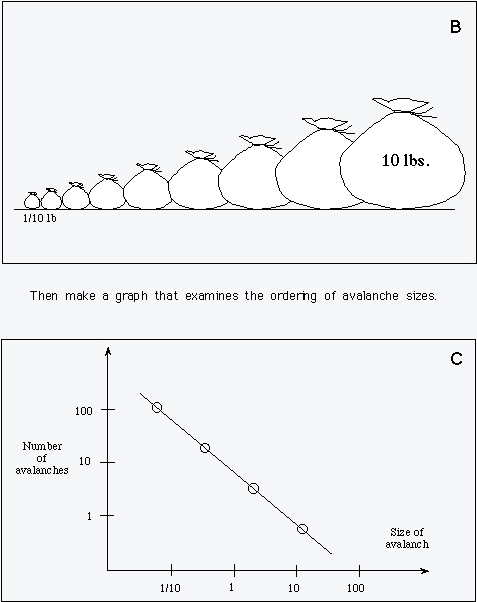
Figure 5.2.4
Note that on this graph we have set out the axes in a different way from normal - equal increments go in powers of ten rather than unit steps. This is called a logarithmic scale and is critical to the analysis.
What we discover when we make such a plot is that there is a clear relationship between avalanche size and number of avalanches, even though we cannot predict the size of any particular avalanche in advance. Part of it may seem a bit obvious in that there are relatively few large avalanches and a great many small ones. But the straight line on a plot like this says that there is a "power law" relationshipbetween avalanche size and frequency of occurrences. That is, the greater occurrence of small landslides is related to the lesser occurrence of large ones. This type of power law behavior is typical of self-organized critical systems. Thus, in an overall system sense there is order in the system. The number of small avalanches is related to the number of large ones in a predictable way, even though individually they cannot be predicted. It turns out that this aspect of systems is very common indeed.
The following site has a simulation of Bak's sandpile experiment. http://zinc.hpac.tudelft.nl/home/thijssen/sand/sandpile.html It is a sand pile on a square horizontal table with vertical planes mounted at two adjacent sides, such that the sand heaps up against these planes and can slide off the table only at the remaining two sides. The simulation draws the sand pile in a perspective view each time a certain number of grains has been added. This number is called ``DrawInterval". The pile is shown in perspective - a color coding is used which indicates the height. Avalanches exceeding some threshold in size are shown in red. You can change the size of the pile (number of columns along one side of the table), the threshold above which avalanches are shown in red, and the number of added grains between two repaintings, called ``DrawInterval''. Furthermore it is possible to rotate the pile using a horizontal and vertical scroll bar. Changing parameters and adjusting the scroll bars is best done after pressing the ``Suspend''-button!
Summarized, Bak's experiment describes how a pile of sand built by the steady dripping
of sand grains from above can quickly move from a regular predictable
system to a highly irregular and unpredictable system with the same
driving force, yet have an underlying order associated with the
relationship between small and large events; something that proves to
be very important for the behavior of earthquakes
As a side note, Per Bak died on October 16, 2002. The following are some testimonials by his colleagues that are worth taking a look at.
http://www.edge.org/documents/bak_index.html
http://www.nbi.dk/~predrag/friends/Bak/