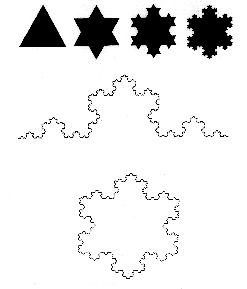
Figure 5.3.1
Introduction to Earth Sciences I
5.3 Self Similarity
This is a simply understood phenomena that is a very powerful analysis tool for many apparently complex systems.
In its basic sense it means that the structure of a system is invariant to magnification or reduction. The term "scale invariance" is sometimes used also.
Self-similar structures are easy to make and the Koch Island is one of the most useful examples.
Another way of stating what a self-similar process is, is to say that a structure formed by a self-similar generator process is one whose shape is independent of the scale at which it is viewed.
|
Thus we keep finding smaller and smaller triangles in the Koch structure; we keep finding triangles of smaller and smaller size in the Sierpinski Gasket, and smaller and smaller cubic holes in the Menger Sponge. One can imagine many variations on this general concept.
When self-similar objects were first recognized, Earth scientist immediately began relating these artificial structures to those seen in nature - the general resemblance of the Koch Island to a real coastline, and the resemblance of a Menger Sponge to a porous rock.
Beyond this general qualitative resemblance is there any way we can show - other than by inspecting structures under increasing magnification - that naturally occurring structures are produced by self-similar generators ? One route is by examining their "dimension".
Dimension is an important concept that is a powerful tool for examining the nature of objects and their generative process. The dimension of an object describes the essential property of its shape or form.
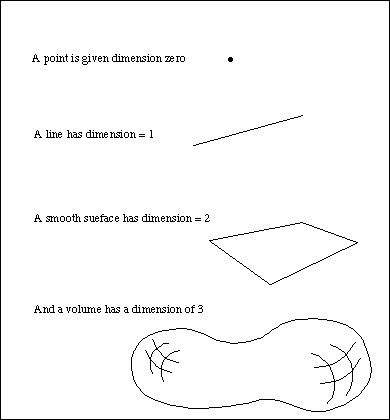
But what is the dimension of an object such as a Koch Island or a Menger Sponge ?
These objects have "fractional dimensions" - dimensions that are not whole numbers (2.3, say). Objects with fractional dimensions are said to be fractals.
So how do we measure or estimate the fractal dimension ? For simple objects the topological dimension is easy to estimate - it's the number of axes we need in space to specify the object. So a line needs one, a surface two, and a volume three. That's easy. We can't measure the dimension of a Koch Island so simply. In fact, we go about it the same way as we estimated the length of a coastline. If we begin with a circle - a simple two-dimensional structure - and did our square counting exercise we would find this.
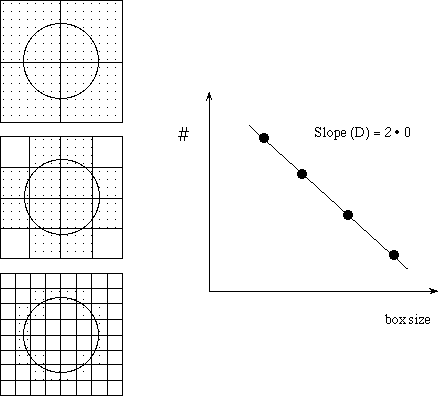
Figure 5.3.3
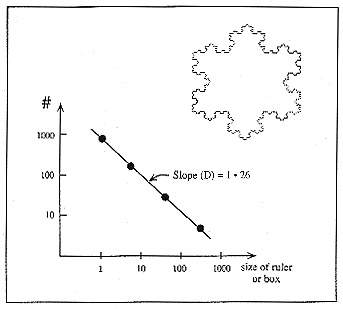
Figure 5.3.4
If we performed the same exercise on a Koch curve the dimension would be 1.26. The dimensions of real coastlines tend to come out at about 1.6. This would suggest that the real coastline generator is not a "times 3" triangle - it might be a "2 1/2 times pentagon", or something else. However, the fact that real coastlines behave as they do suggests some sort of self-similar generator function.
The important result from this type of analysis is that structure that might appear chaotic and be quite unpredictable, and hence be the result of a non-linear process, may have embedded deeply within it a very simple generator process such as a self-similar construction system.
What this means is that chaotic, unpredictable systems have at their roots, deterministic processes.
This was recognized only recently and has revolutionized thinking in many aspects of science.
The practical application of this type of analysis is that it can lead to predictions despite the apparent chaotic nature of the material.
For instance, at Yucca Mountain the Federal Government is spending millions of dollars to assess the suitability of the deep interior of the mountain for storage of high level nuclear waste. The degree to which the earth will retain the waste depends on whether there are pathways for its escape and this depends on how cracked or fractured the rock is. That is, it depends on its fragmented nature. Since diffusion of fluids will occur at a microscopic (perhaps even atomic) scale, and the amount of fluid loss will depend on the total crack length the problem of estimating how cracked the rock is takes on the form of the coastline problem - but with a little more seriousness.
Crack lengths were estimated by grid counting but, of course, grids down to finite size only could be used. However, since the resultant distribution implies a fractal dimension over two orders of magnitude of scale the data can be extrapolated to the finer scale needed to get the accurate measure. Such an approach is not possible if the geometry of the structure is non-fractal.
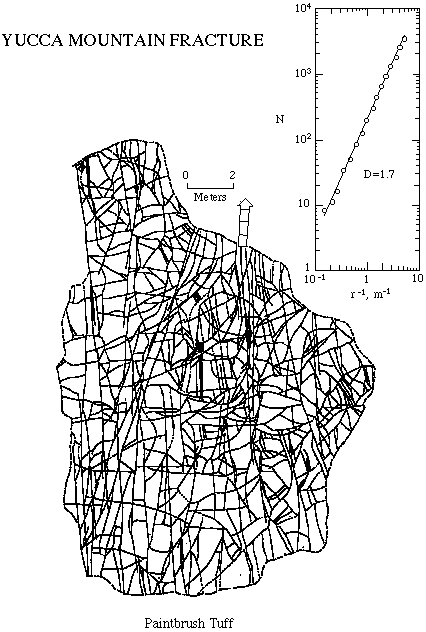
Figure 5.3.5