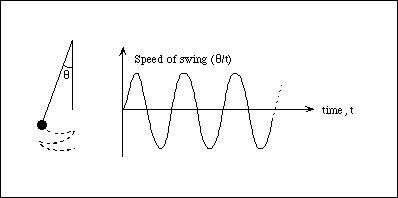
Figure 5.4.1
Introduction to Earth Sciences I
5.4 Linear/Predictable and Non-Linear/Unpredictable Systems
Now let's extend some of the thinking from above to systems in motion. A predictable phenomenon is one whose past history may be used to infer something about its future behavior.
Figure 5.4.1
A classic example is a simple pendulum - if a pendulum is observed to swing three times, we can be pretty sure it will keep swinging, even though, at any instant in time we cannot prove that the pendulum will keep swinging. We have confidence that
1) the swinging will repeat
2) if we start the swing from the same place, the same pendulum will swing the same way.
We can also observe that longer length pendulums have longer swing periods.
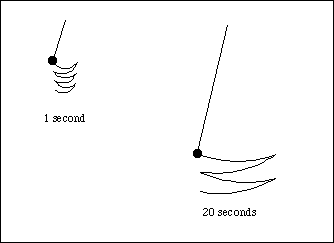
Figure 5.4.2
These things allow us to produce a "theory of pendulum behavior" that can be written in mathematical form. This is an elementary exercise in high school physics.
The equations that describe this system are "linear" equations and are quite simple.
1) If the pendulum were not a linear system we would find that the period of swing might initially change to longer periods as the string increased then suddenly change to shorter periods as the string got longer still.
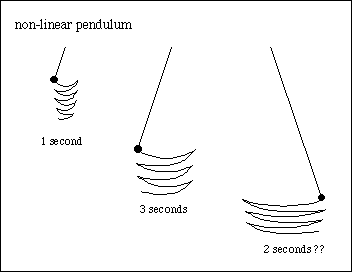
Figure 5.4.3
2) It might also happen that we got a different period of swing if we started it going from the left or the right. That is, if we changed the initial conditions.
A linear system is one in which the output bears a simple relationship to the input. So, for instance, if I bend a steel rod an inch with a force of 10 pounds I might reasonable expect it to bend two inches with a force of 20 pounds, 3 inches for 30 pounds, etc. In a non-linear system the output change cannot be related to the input change in a simple way.
Almost all phenomenon of interest to the Earth scientist do not exhibit a simple linear behavioral characteristic. Most are, at least at some level, unpredictable. Most, therefore, cannot have their future behavior determined from past behavior. Most obey non-linear equations. Most are highly sensitive to initial conditions. If this were not the case we would, for instance, be able to predict exactly where and when earthquakes will occur and how large they will be which, obviously, we cannot.
The Earth's weather is another example. The weather pattern of the past few hours (maybe a couple of days) can be used to predict a short distance ahead in time - forecast - but not much further. Weather forecasting is difficult, fundamentally because it is a complex, non-linear system that is inherently unpredictable. Despite the advent of enormous computer capabilities, weather is hardly more predictable now than it was 50 years ago. It's nobody's fault; it's the nature of the system.
* One example of unpredictable non-linear behavior is achieved by adding a second element - perhaps predictable in its own right - to an initially predictable system.
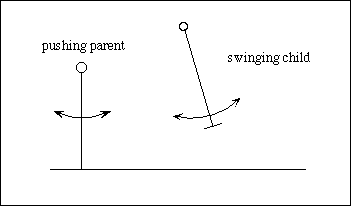
Figure 5.4.4
Imagine a child on a swing performing a simple predictable linear swinging motion. The child is too young to know how to use its legs to keep the swing going and asks a parent to push. The parent pushes rhythmically catching the swing at its highest point and pushing to keep the motion going. This is called a "forced" pendulum. So long as the forcing (the parent's action) is close to the natural period of the swing (governed by the length of the ropes) everything is o.k.
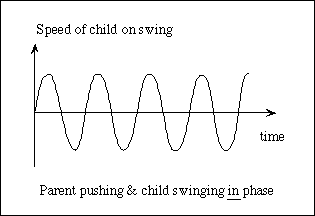
Figure 5.4.5
However, if forcing (the parent) and the swinging (the
child) get out of phase (because the parent zones out thinking about something
else, maybe) the interaction of these two predictable elements gives rise
to a completely unpredictable system. Sometimes the parent catches the swing
on the up-swing and inhibits the motion, sometimes on the downswing and
helps the motion, sometimes the parent misses completely.
Another example is the compound pendulum that is constructed by swinging one pendulum from
the end of another. Individually, both pendulums (if you took the two apart)
behave entirely predictably in a simple repeatable manner. But once joined
together the motion of the end of the attached pendulum becomes completely
unpredictable.Simulations of a compound pendulum's behavior are shown below. As the energy increases, the system becomes more chaotic.
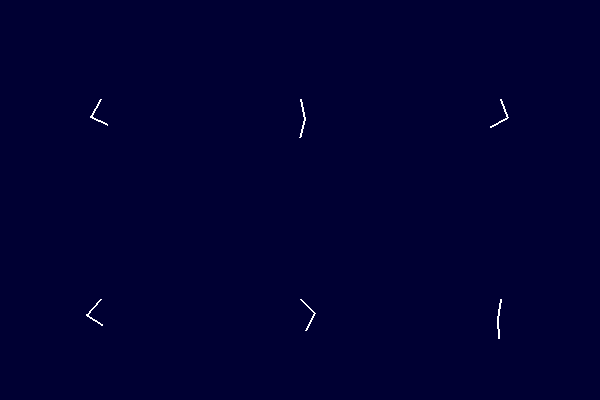
Figure 5.4.6) Energy=1 (non-chaos)
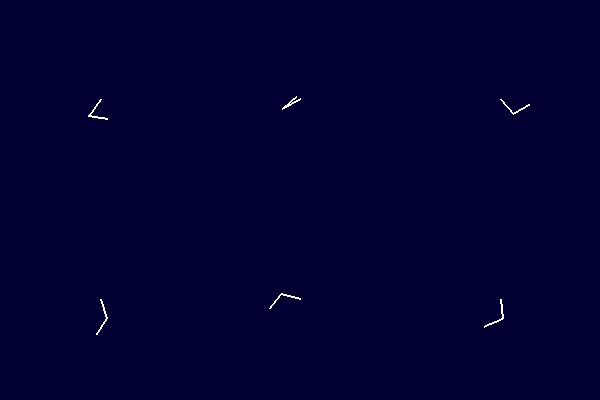
Figure 5.4.7) Energy=3 (weak-chaos)
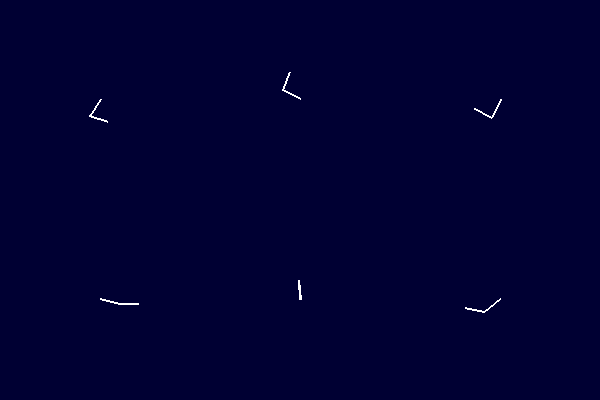
Figure 5.4.8) Energy=5 (chaos)
(Simulations from: http://aurora.elsip.hokudai.ac.jp/yanagita/job/pen/html/index.html)
More complex pendulum systems can be constructed and they
are more unpredictable still. See the source for the simulations site above to view simulations of a compound pendulum made of 5 pendulums.
Because of this the motion of the swing becomes completely unpredictable.
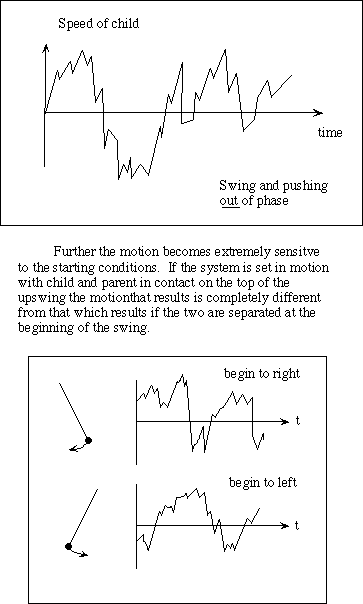
Figure 5.4.9