Figure 5.5.1
Introduction to Earth Sciences I
5.5 Measles in N.Y.C.
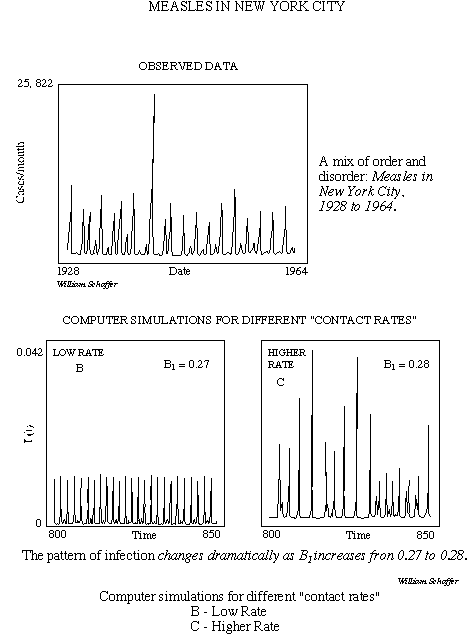
This is another, more complex example, of how simple components of a system can combine to generate a complex unpredictable system.
The disease model is a computer simulation used to try to understand how infection is transmitted as a way of judging how to employ vaccination programs in disease control. Four separate factors contribute to the model. The number of people in four categories -
susceptables (S)
exposed (E)
infected (I)
immune or recovering (R)
This is the SEIR model.
Each of the contributing factors are simple elements - together the behavior is not only complex, but changes in complexity as characteristics of the system change.
In the example, the only change is the contact rate - the degree to which infected people come into contact with those who are not. While it might seem like the process would be simple - the more contacts, the more infections - however, the system is more complex because contact also leads to immunity or recovery following contraction.
The result is that turning up the contact rate initially leads to greater total infections, but as the contact rate increases the system goes chaotic. This could be thought of as the system having linear behavior at low contact rates and non-linear behavior at higher rates, where the rate of infection in any year is not predictable.
* Note - SEIR cannot describe details of how infection is transmitted from individual to individual, but knowledge of transmission process does not lead to population statistics.
What I have been describing is a system that becomes chaotic at a certain range of inputs. The characteristics are:
1) unpredictability (either wholly or partially)
2) sensitivity to initial conditions
3) governed by non-linear processes
The reason for introducing this concept is that it is now widely believed that many phenomenon of interest in the Earth have these characteristics. If this is the case, can we hope to learn anything useful about them? The answer is "yes", but with the qualification that we can't do it in the usual reductionist way and ultimately to understand them.
For instance, it's no good taking a reductionist approach and saying that the route to understanding the swing problem is to analyze its components - the natural periodic motion of the swing and child, and the parent forcing - and put those together. They don't add (or construct) to form an understanding of the behavior of the whole system.
Another example of a system that has chaotic behavior is the fluid dynamic example we created in Topic 3. A fluid heated from below will develop a fairly regular stable set of upwelling centers and downwelling zones. Then, as the heat is turned up more, it will develop an unstable configuration in which centers of upwelling will appear and disappear in an unpredictable manner.
This transition from predictable to unpredictable is very typical of Earth systems.
Figure 5.5.1