Summary of ATP III Recommendations
- Elevated LDL cholesterol is the major cause of coronary heart disease thus ATP III continues to identify elevated LDL as the primary target of cholesterol-lowering therapy.
- A basic principle of prevention is that the intensity of risk-reduction therapy is adjusted based on the person’s absolute risk.
- Risk assessment is based on measurement of the LDL cholesterol and identification of accompanying risk determinant.
STEP ONE: SCREENING
In all adults age 20 or older – a 9 – 12 hour fasting lipoprotein profile (total cholesterol, low density lipoprotein (LDL) cholesterol, high density lipoprotein (HDL) cholesterol, and triglyceride (TG) should be performed once every 5 years. If a fasting lipid panel can not be done, then only the total cholesterol and HDL is appropriate for use.
| ATP III Classification of LDL, Total, and HDL Cholesterol (mg/dL) |
|---|
|
STEP TWO: ASSESSMENT FOR PRESENCE OF HIGH RISK CORONARY HEART DISEASE EQUIVALENTS
Identify presence of clinical atherosclerotic disease that confers high risk
for coronary heart disease (CHD) events (CHD risk equivalent):
- Clinical CHD
- Symptomatic carotid artery disease
- Peripheral arterial disease
- Abdominal aortic aneurysm
- Diabetes is considered a CHD risk equivalent in ATP III
STEP THREE: ASSESSMENT OF MAJOR RISK FACTORS
Determine presence of major risk factors (other than LDL) That Modify LDL Goals:
- Cigarette smoking
- Hypertension (BP >140/90 mmHg or on antihypertensive medication)
- Low HDL cholesterol (<40 mg/dL)*
- Family history of premature CHD (CHD in male first degree relative <55 years; CHD in female first degree relative <65 years)
- Age (men >45 years; women >55 years)
*HDL cholesterol ≥60 mg/dL counts as a “negative” risk factor; its presence removes one risk factor from the total count.
STEP FOUR: IF 2 OR MORE MAJOR RISK FACTORS OTHER THAN LDL ARE PRESENT THEN ASSESS 10-YEAR CHD RISK
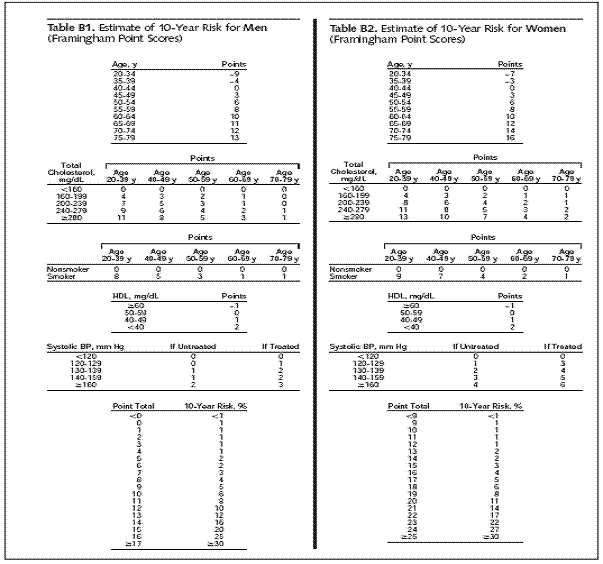
If 2+ risk factors (other than LDL) are present without CHD or CHD risk equivalent, assess 10-year (short-term) CHD risk (see Framingham tables).
Three levels of 10-year risk are:
- >20% — this is considered a CHD risk equivalent
- 10-20%
- <10%
A 10 year risk factor >20% means that 20 out of 100 individuals will develop coronary heart disease or a coronary event within 10 years.
STEP FIVE: DETERMINE THE RISK CATEGORY
Determine risk category by:
- Establishing LDL goal of therapy
- Determining need for therapeutic lifestyle changes (TLC)
- Determining level for drug consideration
| LDL Cholesterol Goals and Cutoff Points for Therapeutic Lifestyle Changes (TLC) and Drug Therapy in Different Risk Categories |
|||
|---|---|---|---|
| Risk Category | LDL Goal | LDL level at which to initiate TLC | LDL level at which to consider drug therapy |
| CHD or CHD Risk Equivalents (10 year risk factor >20%) | <100 mg/dL | ≥100 mg/dL | ≥130 mg/dL (100-129 mg/dL: drug optional)* |
| 2+ Risk Factors (10 year risk factor ≤20%) | <130 mg/dL | ≥130 mg/dL | 10-year risk 10-20%: ≥130 mg/dL |
| 10-year risk <10%: ≥160 mg/dL |
|||
| 0-1 Risk Factor† | <160 mg/dL | ≥160 mg/dL | ≥190 mg/dL (160-189 mg/dL: LDL-lowering drug optional) |
|
* Some authorities recommend use of LDL-lowering drugs in this category if an LDL cholesterol <100 mg/dL cannot be achieved by therapeutic lifestyle changes. Others prefer use of drugs that primarily modify triglycerides and HDL, e.g., nicotinic acid or fibrate. Clinical judgment also may call for deferring drug therapy in this subcategory. † Almost all people with 0-1 risk factor have a 10-year risk <10%, thus 10-year risk assessment in people with 0-1 risk factor is not necessary. |
|||
STEP SIX: THERAPEUTIC LIFESTYLE CHANGES

Initiate therapeutic lifestyle changes (TLC) if LDL is above goal.
- TLC Diet:
- Saturated fat <7% of calories, cholesterol <200 mg/day
- Consider increased viscous (soluble) fiber (10-25 g/day) and plant stanols/sterols (2g/day) as therapeutic options to enhance LDL lowering
- Weight management
- Increased physical activity

Table from Adult Treatment Panel III. Executive Summary of the Third Report
of the National Cholesterol Education Program (NCEP) Expert Panel on Detection, Evaluation,
and Treatment of High Blood Cholesterol in Adults JAMA, May 16, 2001
Further patient education links about hyperlipidemia is available in the library.
STEP SEVEN: CONSIDER DRUG THERAPY
| LDL Cholesterol Goals and Cutoff Points for Drug Therapy in Different Risk Categories | ||
|---|---|---|
| Risk Category | LDL Goal | LDL level at which to consider drug therapy |
| CHD or CHD Risk Equivalents (10 year risk factor >20%) | <100 mg/dL | ≥130 mg/dL (100-129 mg/dL: drug optional)* |
| 2+ Risk Factors (10 year risk factor ≤20%) | <130 mg/dL | 10-year risk 10-20%: ≥130 mg/dL |
| 10-year risk <10%: ≥160 mg/dL |
||
| 0-1 Risk Factor† | <160 mg/dL | ≥190 mg/dL (160-189 mg/dL: LDL-lowering drug optional) |
|
* Some authorities recommend use of LDL-lowering drugs in this category if an LDL cholesterol <100 mg/dL cannot be achieved by therapeutic lifestyle changes. Others prefer use of drugs that primarily modify triglycerides and HDL, e.g., nicotinic acid or fibrate. Clinical judgment also may call for deferring drug therapy in this subcategory. † Almost all people with 0-1 risk factor have a 10-year risk <10%, thus 10-year risk assessment in people with 0-1 risk factor is not necessary. |
||
- Consider drug simultaneously with TLC for CHD and CHD equivalents
- Consider adding drug to TLC after 3 months for other risk categories.

Table from Adult Treatment Panel III. Executive Summary of the Third Report
of the National Cholesterol Education Program (NCEP) Expert Panel on Detection, Evaluation,
and Treatment of High Blood Cholesterol in Adults JAMA, May 16, 2001
Ezetimibe
Ezetimibe is a new anti-lipidemic drug. It is in a class of lipid-lowering compounds that selectively inhibits the intestinal absorption of cholesterol and related phytosterols. It is used as an adjunct with a statin when a statin alone does not achieve LDL goals or used alone if statins are not tolerated or contraindicated in a patient. A recent study published in the New England Journal of Medicine surprisingly found that despite a remarkable drop in LDL and C-reactive protein levels when ezetimibe is used in conjunction with a statin, in patients with familial hypercholesterolemia, combined therapy with ezetimibe and simvastatin did not result in a significant difference in changes in intima?media thickness, as compared with simvastatin alone (NEJM, 2008). The full article is located in the library: Simvastatin with or without Ezetimibe in Familial Hypercholesterolemia.
Omega-3 Fatty Acids
Recent clinical trials suggest that relatively high intakes of n-3 fatty acids in the form of fish, fish oils, or high-linolenic acid oils can reduce risk for major coronary events in persons with established CHD (secondary prevention). More clinical evidence is needed to make recommendations on higher doses for primary prevention.